
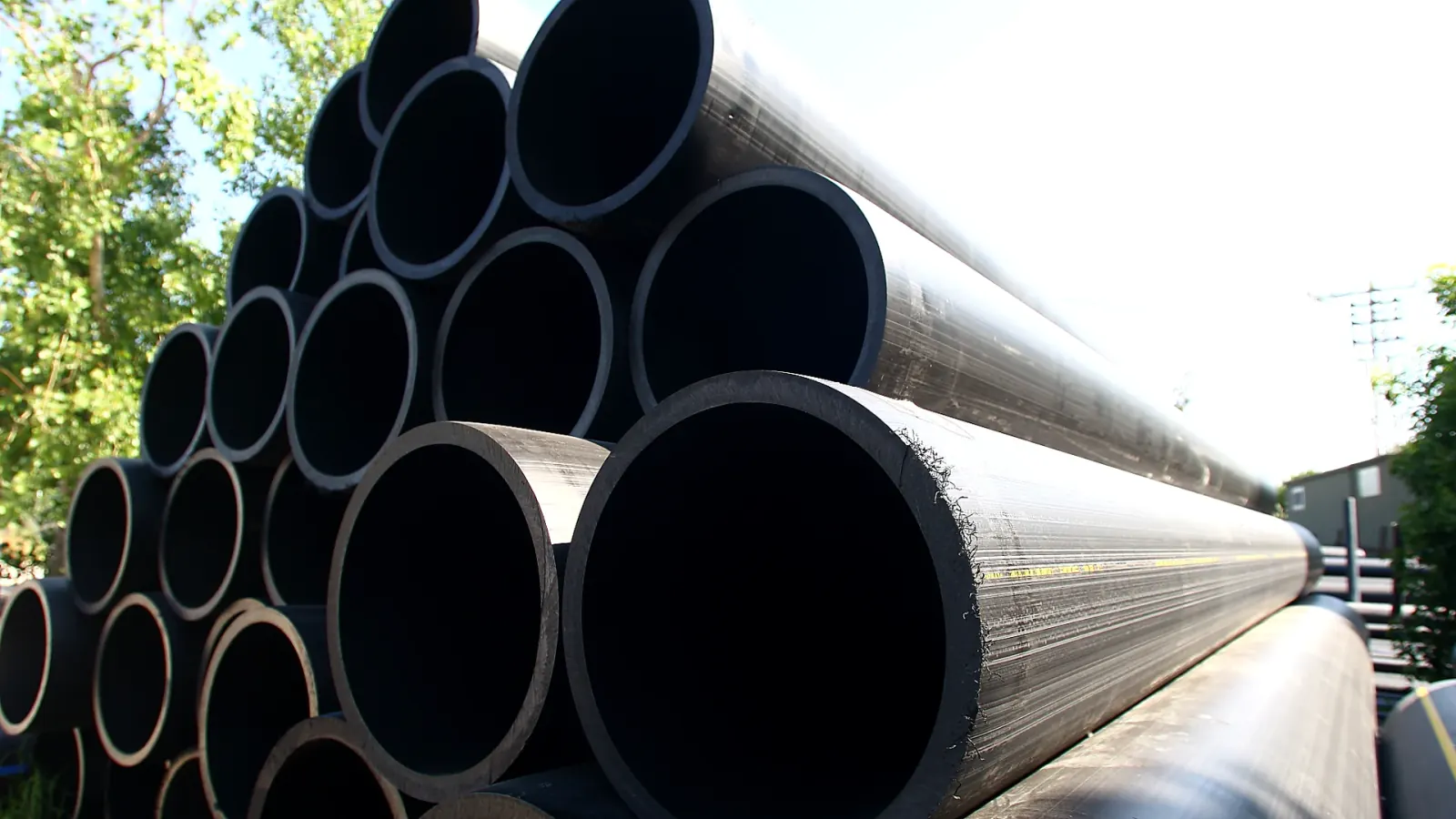
TECHNICAL GUIDE
PE100 vs PE100RC
Two material designations, one shared polymer base — and a single critical difference that shapes the service life of your pipeline. Here is what separates them.
MATERIAL BASICS
Two grades, one family.
Both are high-density polyethylene rated PE100. The difference is what happens when the pipe surface is damaged.
PE100
THE INDUSTRY STANDARD
Standard high-density polyethylene (HDPE) — the workhorse of the pressure pipe industry for decades. The "100" stands for a Minimum Required Strength (MRS) of 10.0 MPa, rated for demanding pressure conditions.
PE100RC
RESISTANCE TO CRACK
The same base polymer with one critical enhancement: RC — Resistance to Crack. Developed in 2005 to stop slow crack growth that starts from surface scratches and point loads.
THE KEY DIFFERENCE
Slow Crack Growth
The real distinction between the two grades lies in their performance against slow crack growth (SCG) — the failure mode that decides how long a scratched pipe survives under pressure.
The problem — standard PE100
During installation, PE100 pipes can pick up surface scratches from rocks or sharp objects in the backfill. Under constant pressure and stress, a scratch can slowly grow into a crack that propagates through the pipe wall — sometimes failing decades after installation.
Scratch grows into a through-wall crack
- 01
Surface scratch from a rock or sharp backfill
- 02
Constant pressure and stress concentrate at the notch
- 03
The crack slowly propagates through the pipe wall
- 04
Failure — sometimes decades after installation
The solution — PE100RC
PE100RC is engineered with an enhanced molecular structure that dramatically slows crack propagation. External damage stays as surface damage — it does not develop into a through-wall crack.
Crack arrested at the surface
Surface scratches from installation damage
Point loads from rocks and debris
Rough handling during transport and installation
PROOF, NOT PROMISES
Tested to PAS 1075
The RC grade is defined by the German PAS 1075 specification for alternative installation techniques — requiring a service life of at least 100 years — and four ISO test methods that standard PE100 is not required to pass.
PAS 1075 SPECIFICATION
≥ 100 years
Required service life for pipes used in alternative installation techniques.

| Test method | Requirement | Purpose |
|---|---|---|
| Strain Hardening Test (SHT) | Gp > 53 MPa | Fast assessment of SCG resistance |
| Cracked Round Bar (CRB) | ≥ 1.5 million cycles | Cyclic loading resistance |
| Accelerated Full Notch Creep Test (AFNCT) | 300 h at 5 MPa or 550 h at 4 MPa | Accelerated creep resistance |
| Accelerated Notched Pipe Test (ANPT) | ≥ 300 hours | Full-pipe SCG resistance |
These requirements far exceed those for standard PE100, securing performance in challenging conditions.
ON SITE
Where PE100RC earns its keep
Alternative installation methods expose pipes to higher stress levels — exactly where RC's superior notch resistance provides an extra margin of safety.
Trenchless installation
Directional drilling and pipe bursting where no protective bedding layer is present.
Sandless / native backfill
Installation without processed bedding material.
Plowing & milling
Direct ground insertion methods with high point loads.
Long pipe relining
Rehabilitating existing lines over long distances.
When standard PE100 is sufficient
For traditional open-trench installation on properly prepared sand bedding, PE100 has a proven track record of reliable performance — a cost-effective and dependable choice.
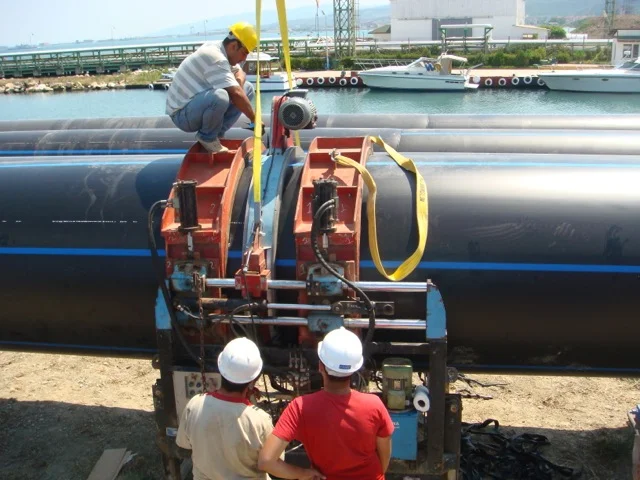
COMPATIBILITY
Welded exactly the same
PE100 and PE100RC are fully compatible. Fusion welding characteristics are identical — same equipment, same procedures — and both grades can even be joined to each other within the same system.
- Same fusion equipment
- Same welding procedures
- Join both grades in one system
HEAD TO HEAD
Making the right choice
Same strength, same weldability — the decision comes down to installation method, soil conditions and the level of risk you accept over the pipeline's life.
| Consideration | PE100 | PE100RC |
|---|---|---|
| MRS rating | 10.0 MPa | 10.0 MPa |
| Slow crack growth resistance | Standard | Enhanced |
| Point load resistance | Standard | Superior |
| Trenchless suitability | Limited | Excellent |
| Sandless backfill | Not recommended | Suitable |
| Welding | Standard | Identical to PE100 |
| Cost | Lower | Higher |
THE BOTTOM LINE
Which one is yours?
Choose PE100RC when…
- Trenchless or low-dig installation methods
- Sandy or rocky native backfill
- Risk of damage during installation
- Target service life beyond 50 years
PE100 remains the choice when…
- Conventional open-trench installation
- Properly prepared sand bedding
- Controlled installation conditions
PE100RC is not a replacement for PE100 — it is an evolution of the same material, engineered against the one failure mode that standard PE100 cannot fully control.
Not sure which grade fits your project?
Tell us about your installation method and soil conditions — our engineers will help you choose the right material.