
BUYER'S GUIDE · BUTT FUSION
How to choose an HDPE butt fusion welding machine
Start with the pipe you have to weld, then the control type, the power on site and the weld records your client expects. We use our own AL and ALW series as the examples, because those are the specifications we publish.
The short answer
- Diameter: choose a machine whose range covers both your smallest and your largest pipe.
- Wall thickness: check the maximum wall (PN) the machine can weld.
- Control: a standard hydraulic machine costs less; a CNC model calculates the weld and produces a report for each joint.
- Power: check the voltage and phase, and the generator size if you work away from mains power.
- Paperwork and support: ask which standard the machine is built to, and who provides manuals, technical support, spare parts and warranty.
Manual, hydraulic or CNC?
The control type decides who does the weld calculation and whether the machine keeps a record of it.
Manual
We do not list a manual butt fusion machine: our AL and ALW series are hydraulic and CNC machines. The manual machine in our range is the hand-held extruder, which lays a bead of molten plastic along the joint and is a different process from butt fusion.
Standard hydraulic
The operator reads the welding pressures and times from the DVS 2207 parameter table and controls each stage of the weld, and the hydraulic unit presses the pipe ends together at the set pressure. It costs less than a CNC model.
CNC
You enter the pipe diameter and wall thickness. The controller works out the heating, change-over and cooling times, runs the cycle, keeps up to 500 welds in memory and produces an original report for each joint. CNC costs more, but it takes the calculation out of the operator's hands.
A CNC model helps most when the client or the utility asks for weld records.
How do I size a machine by pipe diameter?
Every machine has a minimum and a maximum pipe diameter, so check both ends of your job. The AL 500 welds Ø 180–500 mm, which means it will not take Ø 110 mm pipe on the same site.
Then check the wall. Wall thickness depends on the diameter and the pressure class: Ø 315 mm pipe has an 18.7 mm wall in SDR 17 (PN 10) and a 28.6 mm wall in SDR 11 (PN 16). Many AL models weld walls up to PN 32.
Our butt fusion machines weld both PE and PP pipe. Set the heater temperature and pressures for the material you are welding.
Size also affects logistics. The AL 315 ships in one wooden crate at 277 kg gross, and the AL 800 in three crates at 1189 kg gross. Packing details are on the machine pages, so you can plan container or truck space.
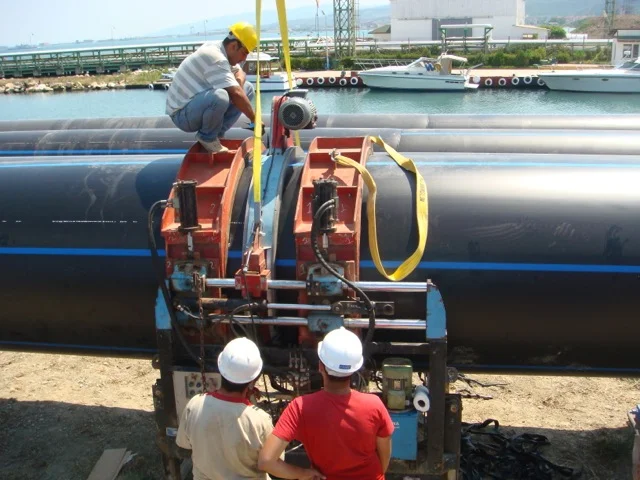
AL and ALW series by pipe diameter
The AL series covers Ø 63 to Ø 1200 mm, and most sizes also come in a CNC version. The ALW A series is the newer generation, built on the AL platform with an updated hydraulic unit, refined controls and extended welding ranges up to Ø 1600 mm.
| Machine | Series | Pipe range | Max wall | Electric supply | Total power | Generator |
|---|---|---|---|---|---|---|
| AL 160 MW | AL | Ø 63 – Ø 160 mm | — | Single phase | — | — |
| AL 160 W | AL | Ø 63 – Ø 160 mm | — | Single phase | — | — |
| ALH 160 CNC | AL | Ø 63 – Ø 160 mm | PN 32 | 230 V, Single phase | 2.8 kW | 4.2 kVA |
| ALHM 160 | AL | Ø 63 – Ø 160 mm | PN 32 | 230 V, Single phase | 2.25 kW | 3.7 kVA |
| ALW 160A | ALW | Ø 63 – Ø 160 mm | — | 220 V / 50 Hz, 1PH | 3.65 kW | — |
| AL 250 CNC | AL | Ø 75 – Ø 250 mm | PN 32 | 230 V, Single phase | 4.8 kW | 6.5 kVA |
| ALW 250A | ALW | Ø 63 – Ø 250 mm | — | 220 V / 50 Hz, 1PH | 5.05 kW | — |
| AL 315 CNC | AL | Ø 90 – Ø 315 mm | PN 32 | 230 V, Single phase | 4.8 kW | 8.0 kVA |
| ALW 315A | ALW | Ø 90 – Ø 315 mm | — | 220 V / 50 Hz, 1PH | 5.85 kW | — |
| ALW 400A | ALW | Ø 180 – Ø 400 mm | — | 380 V / 50 Hz, 3PH | 7.7 kW | — |
| AL 500 CNC | AL | Ø 180 – Ø 500 mm | PN 32 | 380 V, Triple phase | 7.15 kW | 12 kVA |
| ALW 500A | ALW | Ø 180 – Ø 500 mm | — | 380 V / 50 Hz, 3PH | 9.1 kW | — |
| AL 630 CNC | AL | Ø 315 – Ø 630 mm | PN 32 | 380 V, Triple phase | 9.75 kW | 16 kVA |
| ALW 630A | ALW | Ø 315 – Ø 630 mm | — | 380 V / 50 Hz, 1PH | 10.1 kW | — |
| AL 800 CNC | AL | Ø 500 – Ø 800 mm | PN 32 | 380 V, Triple phase | 12.25 kW | 20 kVA |
| ALW 800A | ALW | Ø 450 – Ø 800 mm | — | 380 V / 50 Hz, 3PH | 16.2 kW | — |
| AL 1000 CNC | AL | Ø 710 – Ø 1000 mm | — | Triple phase | — | — |
| ALW 1000A | ALW | Ø 630 – Ø 1000 mm | — | 380 V / 50 Hz, 3PH | 24.5 kW | — |
| AL 1200 CNC | AL | Ø 800 – Ø 1200 mm | — | Triple phase | — | — |
| ALW 1200A | ALW | Ø 800 – Ø 1200 mm | — | 380 V / 50 Hz, 3PH | 30.5 kW | — |
| ALW 1600A | ALW | Ø 1000 – Ø 1600 mm | — | 380 V / 50 Hz, 3PH | 61.5 kW | — |
A dash means the value is not in our published specifications; ask us for it. The CNC tag means the same size is also available as a CNC model.
Polyethylene Pipe Butt Welding MachinesWhat power supply does a butt fusion machine need?
Check three things: the voltage and phase, the total power, and the generator size if you work away from mains power.
In the AL series, machines up to Ø 315 mm are single-phase on 230 V and the larger three-phase machines run on 380 V. In the ALW A series, models up to Ø 315 mm take 220 V / 50 Hz and the larger ones 380 V / 50 Hz.
Demand rises with diameter. The AL 315 has a total power of 4.8 kW and needs a generator of at least 8 kVA, the AL 800 has 12.25 kW and needs at least 20 kVA, and the ALW 1600A has a total power of 61.5 kW.
Do I need data logging and weld reports?
You need them if your client or the utility asks for weld records. On our CNC models the controller keeps up to 500 welds in memory and produces an original report for each joint.
On a standard hydraulic machine the welding pressures and times come from the DVS 2207 parameter table and the operator controls each stage. We do not list weld memory or reports for these models, so if records matter, choose CNC. In our range the CNC models run from the ALH 160 CNC to the AL 1200 CNC; no ALW A model is listed with CNC control.
Whichever supplier you use, ask what the report shows, how you get it off the machine and how many welds the memory holds.
If the same job also uses electrofusion fittings, those machines keep records too: the HCU 300 MINI and HST 300 EASY D 2.0 hold up to 500 welds, and the W 500 and W 1600 up to 4000, with barcode scanning.
Electrofusion Welding MachinesWhich standards should the machine meet?
Ask which standard the machine is built to, which procedure the weld parameters follow, and for the documents that show it.
TS ISO 12176-1
The standard we build our AL and ALW machines to.
DVS 2207
The welding practice our procedure follows. Each machine page has the step-by-step procedure and a parameter table under Technical Guides.
Certificates
The Certificates Booklet on our Resources page collects ISO, CE and product certification documents in one file.
What should I check in after-sales support?
Ask these questions before you order, and keep the answers with the quote.
Technical support
Who do you call when a machine has a problem on site? At Turan Borfit, Borfit is our commercial and sales division, and it handles distribution, exports and technical support.
Manuals and training
Is there a manual covering operation, safety and maintenance, and is there training material for operators? The AL series manual is on our Resources page, and catalogs, user manuals and training videos are available on request.
Spare parts and warranty
Ask which parts are available, how quickly they reach you and what the warranty covers. We do not publish these terms on this site, so ask us for them with your quote.
Reach
Does the supplier already work in your country? Turan Borfit serves customers in more than 70 countries, with dedicated after sales support.
FAQ
Frequently asked questions
What size butt fusion machine do I need?
One whose range covers both your smallest and your largest pipe. For Ø 110 to Ø 315 mm pipe, for example, the AL 315, AL 315 CNC and ALW 315A all fit, with a range of Ø 90–315 mm.
Should I buy a hydraulic or a CNC butt fusion machine?
A standard hydraulic machine costs less, and the operator reads the pressures and times from a table. A CNC model costs more, but it calculates the weld from the pipe diameter and wall thickness you enter, keeps up to 500 welds in memory and produces an original report for each joint.
What power supply does a butt fusion machine need?
It depends on the size. In our AL series, machines up to Ø 315 mm are single-phase on 230 V and the larger three-phase machines run on 380 V. The AL 315 needs a generator of at least 8 kVA and the AL 800 at least 20 kVA.
Do butt fusion machines produce weld reports?
Our CNC models do: they keep up to 500 welds in memory and produce an original report for each joint. We do not list weld memory or reports for our standard hydraulic models.
Which standards apply to butt fusion machines?
Our AL and ALW machines are built to TS ISO 12176-1, and the welding procedure follows DVS 2207.
What is the difference between the AL and ALW series?
The ALW A series is the newer generation, built on the AL platform with an updated hydraulic unit, refined controls and extended welding ranges up to Ø 1600 mm. The AL series covers Ø 63 to Ø 1200 mm, and most sizes also come in a CNC version.
What should I ask about after-sales support?
Ask who provides technical support, whether manuals and training material are available, which spare parts you can get and how quickly, and what the warranty covers. We do not publish spare parts or warranty terms on this site, so ask us for them with your quote.
Not sure which machine fits?
Send us your pipe diameters, your pressure class and the power you have on site, and ask for a quote.